
Handheld fiber laser welding machines are transforming metal processing in the age of Industry 4.0. These machines combine high-precision laser technology with easy-to-use operation. As a result, they offer a powerful alternative to traditional welding methods like arc and TIG welding. Manufacturers are increasingly adopting these machines due to their efficiency, precision, and flexibility. This technology is setting a new standard for intelligent manufacturing. It is not only enhancing productivity but also driving forward modern manufacturing processes globally.
Key Features of Handheld Fiber Laser Welding
The core of this technology is the fourth-generation dynamic compensation welding gun. It provides ±2° amplitude adjustment, enhancing precision. The machine also uses a 1064/1080nm fiber laser from trusted brands like IPG or SPI. This ensures high-quality performance and reliability. The intelligent autofocus system allows the machine to achieve 0.1mm positioning accuracy. This is achieved over a working distance of 3–20mm, which is ideal for intricate welding tasks. The dual-mode system supports both continuous and pulse welding (1–1000Hz). This feature enhances versatility, allowing the machine to handle a wide variety of applications. The 7-inch touchscreen offers over 20 preset programs. This makes it easy for operators to adjust settings, whether working with materials as thin as 0.2mm or as thick as 8mm. The machine comes with an IP54 protection rating as standard. Additionally, manufacturers can choose an optional IP65 rating for harsher environments. This ensures stable operation in all kinds of working conditions.
Wide-Ranging Industry Applications
In the automotive industry, manufacturers rely on this machine to weld battery trays and exhaust systems. It can achieve speeds of up to 5 meters per minute on 2mm stainless steel. This speed, combined with exceptional precision, makes it an essential tool for high-volume production. In construction, the machine is used to weld elevator panels and steel structures. It produces a narrow heat-affected zone of just 0.3–0.8mm, which is critical for maintaining the strength of welded materials. In the home appliance industry, the machine enables seamless welding of refrigerator shells and range hood ducts. It achieves an impressive yield rate of 99.6%. In the growing new energy sector, it efficiently handles tasks such as solar bracket welding and wind power component maintenance. It provides up to five times the welding efficiency of traditional TIG welding, making it faster and more cost-effective. This versatility allows the machine to serve a broad range of industries and deliver real value across various applications.
Advantages Over Traditional Welding Methods
Handheld fiber laser welding offers several advantages over traditional methods. It reduces energy consumption by up to 60%, making it a more efficient solution for manufacturers. Despite using less energy, it matches the output of four TIG machines. This drives productivity to new heights. The consumable-free design lowers welding costs to just $0.50 per meter. This leads to significant savings for businesses. AI-powered, real-time weld monitoring ensures that porosity stays below 0.2% and deformation remains under 0.1mm. This guarantees consistent, high-quality results. Operators with little or no prior welding experience can become proficient in just four hours. This reduces the learning curve and allows businesses to quickly scale up operations. Additionally, the machine features Augmented Reality (AR) guidance. This simplifies complex welds, enabling operators to achieve high-precision results even in more challenging tasks. As a result, manufacturers benefit from faster training, reduced error rates, and increased operational efficiency.
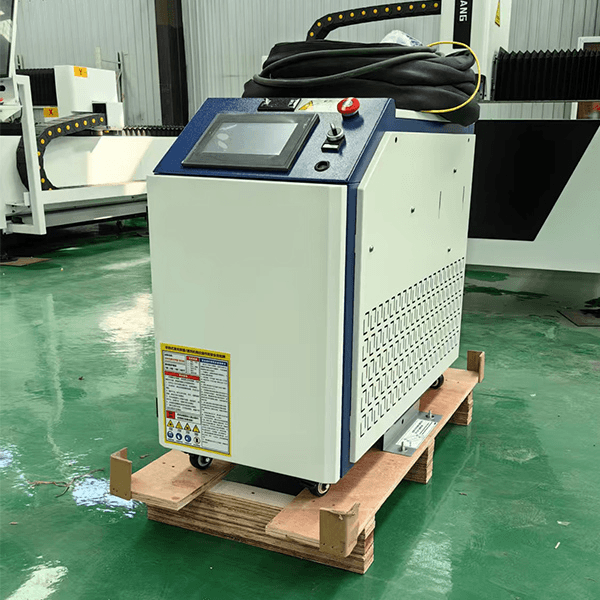
2024 Model Upgrades
The latest model comes with several important upgrades. It introduces a hybrid laser-arc welding head, which exceeds the previous 12mm carbon steel welding limit. This allows the machine to handle tougher jobs with greater ease and efficiency. Additionally, the new portable, battery-powered version operates off-grid for up to four hours. This makes it ideal for onsite repairs of large equipment such as ships and tanks, where power sources may be unavailable. The upgraded model also includes an intelligent maintenance system. This system predicts filter replacement every 500 hours, helping to reduce maintenance costs by 30%. The predictive maintenance function keeps the machine in optimal condition, lowering downtime and extending its lifespan.
Return on Investment and Real-World Impact
The 1500W model, priced between $15,000 and $20,000, typically pays for itself within six to twelve months. For example, an automotive parts manufacturer replaced six MIG welding stations with only two handheld fiber laser welders. This move saved the manufacturer $187,000 annually. Additionally, it reduced the defect rework rate from 5.8% to just 0.3%. This case demonstrates the high return on investment manufacturers can expect. The machine not only cuts operational costs but also improves product quality. This makes handheld fiber laser welding a valuable asset for businesses looking to optimize their operations.
The integration of AI-driven visual positioning and 5G remote capabilities is further advancing the shift to smarter, more flexible manufacturing. Whether used for delicate electronics or large-scale industrial projects, this technology is redefining the future of metal joining. Manufacturers who embrace this innovation are not just adapting to trends—they are leading the way in modern manufacturing.
Welcome to order from us and take the next step in revolutionizing your manufacturing processes.


 English
  Spanish
  Russian